Created in the project EntreComp 360, coordinated by Haskoli Island, supported by the European Union. With contributions of Democracy and Human Rights Education in Europe, Haskoli Island, Bantani Education, Consorzio Materahub Industrie Culturali e Creative, Innogate to Europe SL, The Women’s Organisation Ltd , and Not a Bad Idea Ltd.
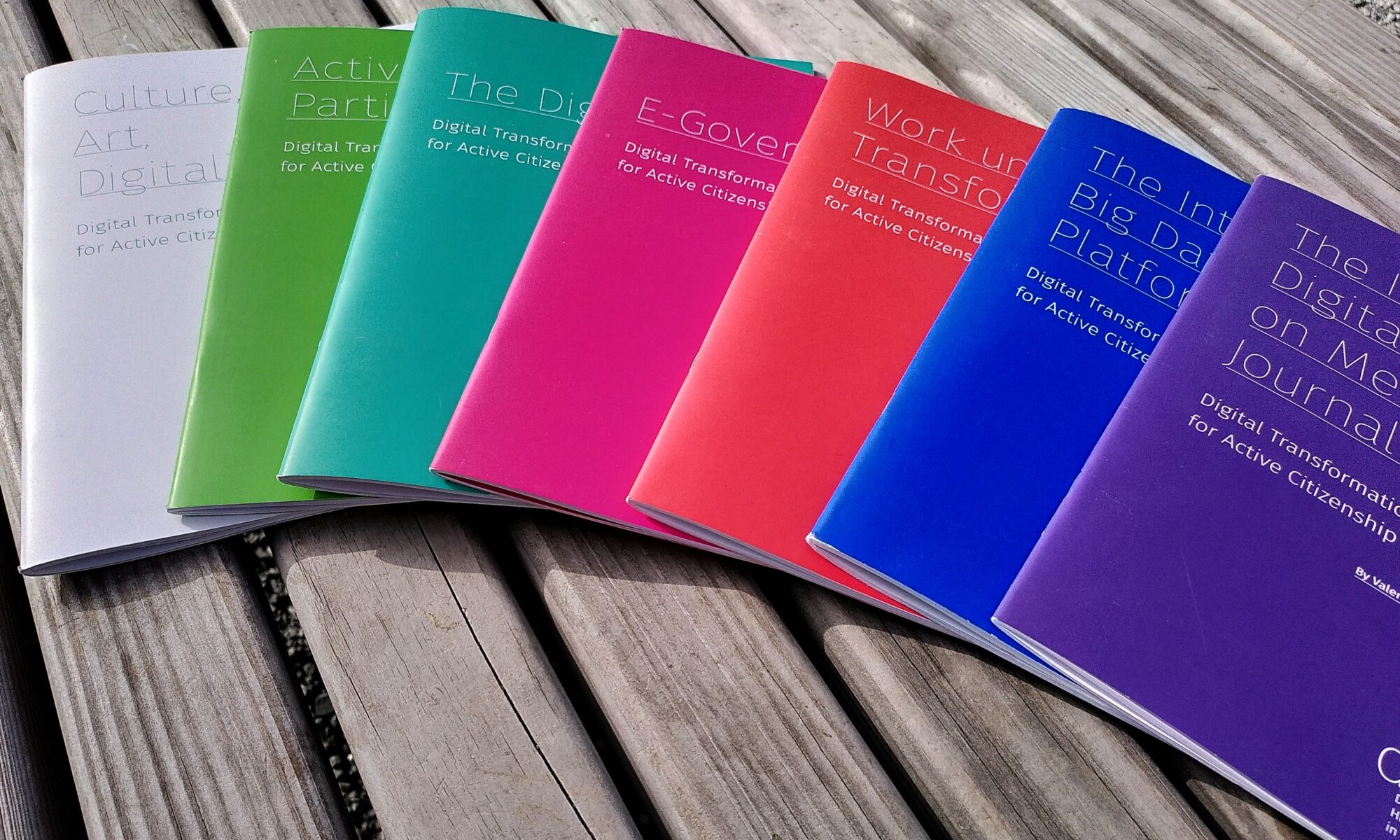
Cite: Georg Pirker (2021). Culture, Art & Digitalisation. Digital Transformation in Learning for Active Citizenship. DARE Blue Lines, DARE – Democracy and Human Rights Education in Europe, Brussels
With contributions from: Christiane Enkeler, Frank Elbers, Nils-Eyk Zimmermann
Digital Transformation impacts the field of arts and culture, but how do artists understand and explore digitalisation? The brochure explores how artists and art research are discussing the transformative process and to what initiatives and new dimensions of culture it could lead. On example of various practices it investigates the arts undergoing a change far beyond the field of production and “consumption”, exposing us to new philosophical frontiers of our understanding of nature and culture. Furthermore, it explores deeper what kind of questions and approaches arts and culture could offer also for civic education.
From the Table of Content
Introduction: Between Zero and One? Digital Everyday Culture Web Culture Characteristics of a Network Arts Arts, Culture and Civic Education
The Internet Cultures Interview with Joana Moll
Work between URL and IRL Work in the Networked Society Transformative Spaces for Digital Arts: Museums, Congresses, Festivals Interview with Aline Lara Rezende by Frank Elbers Glitches: From Euphoria to Datafication and Control Market and State-driven Surveillance Datafication and Immersive Art Approaches Supernerds – Article by Christiane Enkeler
Artificial Intelligence Creativity or Not? The Next Rembrandt
Inside and Insights of the Cultural Industry Algorithms and the Creative IndustryMusicPerforming ArtsLiterature and Writing Film Gaming as Learning Space, Games and Art The Great Art Upgrade by Paolo Pedercini Robots – Imagery of Digitalisation by Nils-Eyk Zimmermann
Cite: Nils-Eyk Zimmermann (2020). Internet, Big Data & Platforms. Digital Transformation in Learning for Active Citizenship. DARE Blue Lines, DARE – Democracy and Human Rights Education in Europe, Brussels
Platformisation of the European economy, automatisation, additive factoring and the (global) redefinition of value chains and collaboration processes are digital drivers of industrial transformation. Obviously, these developments also have an impact on concrete working conditions, although the differences among countries and also sectors are remarkable. Working spaces have also become more technologically enhanced. One result of digitalisation and rationalisation is job polarisation, an increase of high-profile and low-profile jobs while those in the middle vanish. On the other hand, platforms are creating a new kind of working environment. In particular this brochure also highlights how education policies and training strategies might respond to these challenges. It ends with scenarios in regard to (un)employment and labour and with the idea of a universal basic income, which has received increasing support thanks to discussions about digital transformation.
Cite: Ramón Martínez and Georg Pirker (2021). Education & Learning. Digital Transformation in Learning for Active Citizenship. DARE Blue Lines, DARE – Democracy and Human Rights Education in Europe, Brussels
Co-authors: Daniela Kolarova, Ingūna Irbīte, Elisa Rapetti. With contributions from Mike Coterell, Snežana Bačlija Knoch, Frank Elbers, Jöran Muuß-Meerholz
Digital transformation has an impact on learning in all ages and situations and is influencing the education and training sector. Education for Democratic Citizenship and Human Rights Education can play a specific role in this transformation and this focus might also affect what kind of digital competencies education is aiming to facilitate. Certainly the education sector itself is a space where digital instruments are more and more included. Therefore the brochure is asking what characterizes digital didactics and digital learning describe, especially in relation and complementary to “analogue” learning spaces. It ends with an outlook to the new practices in the field of recognition of learning – open badges and micro-credentialing.
From the Table of Content
Education, a Dimension of Digitalisation – Digitalisation, a Dimension of Education?
Impact of Digital Transformation (Adult) Education and Training by Daniela Kolarova
Education in the Digital Divide by Elisa Rapetti Interview with Dino, Maurizio and Mara Pieri from Informatics Without Borders
Competences for the Digital Transformation by Ramón Martínez
The Teacher as an Adult Learner by Ingūna Irbīte
There is no Digital Didactics by Jöran Muuß-Meerholz
I Know How to Teach, Do I Know How to Do it Digitally? by Ramón Martínez
Future of Recognition? Micro-credentialling: Open Badges in Non-formal Education by Mike Cotterell Avenues for Self-assessment and Competence-based Professional Development: The Case of AppRaiser by Snežana Bačlija Knoch
Cite: Valentina Vivona & Niccolò Caranti (2020). The Impact of Digitalisation on Media and Journalism. Digital Transformation in Learning for Active Citizenship. DARE Blue Lines, DARE – Democracy and Human Rights Education in Europe, Brussels
Digitalisation has changed journalism in the last two decades. The digital revolution has created a high-choice media environment, and one of the consequences has been (paradoxically?) news avoidance. Another appearance in recent years has been so-called “fake news” or “disinformation” which we discuss under the topic “information disorder”, which has a wider meaning. Next, we examine new information models as possible ways out, including investigative journalism, explanatory reporting, solutions journalism, constructive journalism, and data journalism. Finally, we focus on media literacy as an educational response to cope with the new media environment.
Cite: Sulev Valdmaa, Mark Andre Udikas (2020). E-Governance. Digital Transformation in Learning for Active Citizenship. DARE Blue Lines, DARE – Democracy and Human Rights Education in Europe, Brussels
The digital transition in regard to governments has made all societies focus on security, democracy and data protection issues. In some countries, digitalisation has moved more quickly and is more wide-spread than in others. However, digitalisation has become an unstoppable process, and it is most useful to analyse all kinds of threats and risks and evaluate already existing experiences and achievements in e-government. Estonia is considered to be one of the pioneers and pathfinders in the digital transition of public services and infrastructure, as it was one of the first to start developing e-governance with wide digital possibilities. We introduce, how Estonia has established its e-society and changed also the understanding of people as (digital) citizens with access to tools and platforms that have become essential to participate in society. In consequence, everybody today needs digital citizenship skills to fully participate in the social life of their communities.
Cite: Nils-Eyk Zimmermann (2020). Internet, Big Data & Platforms. Digital Transformation in Learning for Active Citizenship. DARE Blue Lines, DARE – Democracy and Human Rights Education in Europe, Brussels
Contributors: With guest contributions of Viktor Mayer-Schönberger, Manuela Lenzen, José van Dijck and Irights.Lab.
Cite: Elisa Rapetti & Ricardo Vieira Caldas (2020). Activism & Participation. Digital Transformation in Learning for Active Citizenship. DARE Blue Lines, DARE – Democracy and Human Rights Education in Europe, Brussels
With contributions of: Diego Ceccobelli, Gustavo Briz, Nils-Eyk Zimmermann & Sulev Valdmaa
Social movements’ transform (digitally) and also the idea and ways of active participation. The authors underline the relevance of both online and offline forms of participation in a world where (hack)tivists and movements play an increasingly major role in local communities and in the global processes. From the tech universe to social feminist organizations, they highlight movements that have mapped out an important path in empowering citizens and brought citizens’ voices into the public. The brochure concludes with some reflection about how participation will change in the future and about the necessary competences for participation of citizens under the conditions of the (digital) transformation age.
From the Table of Content
New on/offline behaviours & hacktivism Interview with Diego Ceccobelli Can Offline Communities Significantly Change as a Result of Digital Transformation? Digital Feminism and #Hashtag Activism #BlackLivesMatter
Plural forms of participation How to Make Digital Participation Inclusive?
Trust and Participatory Governance (by Nils-Eyk Zimmermann)
Cite: Nils-Eyk Zimmermann (2020). The Digital Self. Digital Transformation in Learning for Active Citizenship. DARE Blue Lines, DARE – Democracy and Human Rights Education in Europe, Brussels
With a contribution by Bertolt Meyer, co-edited by: Ramón Martínez and Elisa Rapetti
The question of how digitalisation instigates changes to our body, our social identity and our self-image is becoming apparent. This chapter describes the conditions and aspects constituting a digital identity. One important aspect is the machine-human relationship and its underlying constructive conditions. Another is the identificatory aspect of digital technology – the tension between privacy and identifiability (and for whom), and also we need to explore mechanisms of exclusion and inclusion. Therefore, digital transformation has an impact on the ideas of privacy and autonomy and how they might be achieved in the digital social reality, especially under the conditions that big data and datafication create. The second part tackles the question of how the exposure to and embeddedness in digital interaction affects the abilities and attitudes of us as individuals.
From the Table of Content
Into the Internet of Everything Gain of Intuition, Loss of Overview Body-Machine-Interaction Disabled or Cyborg? Interview with Bertolt Meyer, Biometry and Identification Privacy Processing and Refinement of Personal Data Market Regulation
Mentally controlled by data? Impact on Health Promoting Conformism? Impact on Abilities and Competences
DARE BLUE LINES: Competences for Democratic Culture in the Non-Formal Educational Sector
Patricia Hladschik, Claudia Lenz, Georg Pirker (Ed.) With articles of Ole Jantschek, Laura Meijer, Simon Oesterle, Hanna Lorenzen, Thimo Nieselt and contributions from Paola Carega, Nils-Eyk Zimmermann, Ramón Martínez. 91 pages, DARE Blue Lines 2020
How can the RFCDC interplay with other competence frameworks? How can a competence based approach contribute to build a bridge between the inherent field logics of formal and non-formal education? Where are practical benefits and limitations? An extensive field study and practice test allowed to draw findings for the field of cooperation between different sectors of learning, for using the RFCDC as a tool to support peer-learning, and as a reflection instrument for the design and conduction of non-formal learning processes, of educational practice and to support educators in EDC/HRE reflecting about their role and position in learning and educating, for, through and and about democracy.