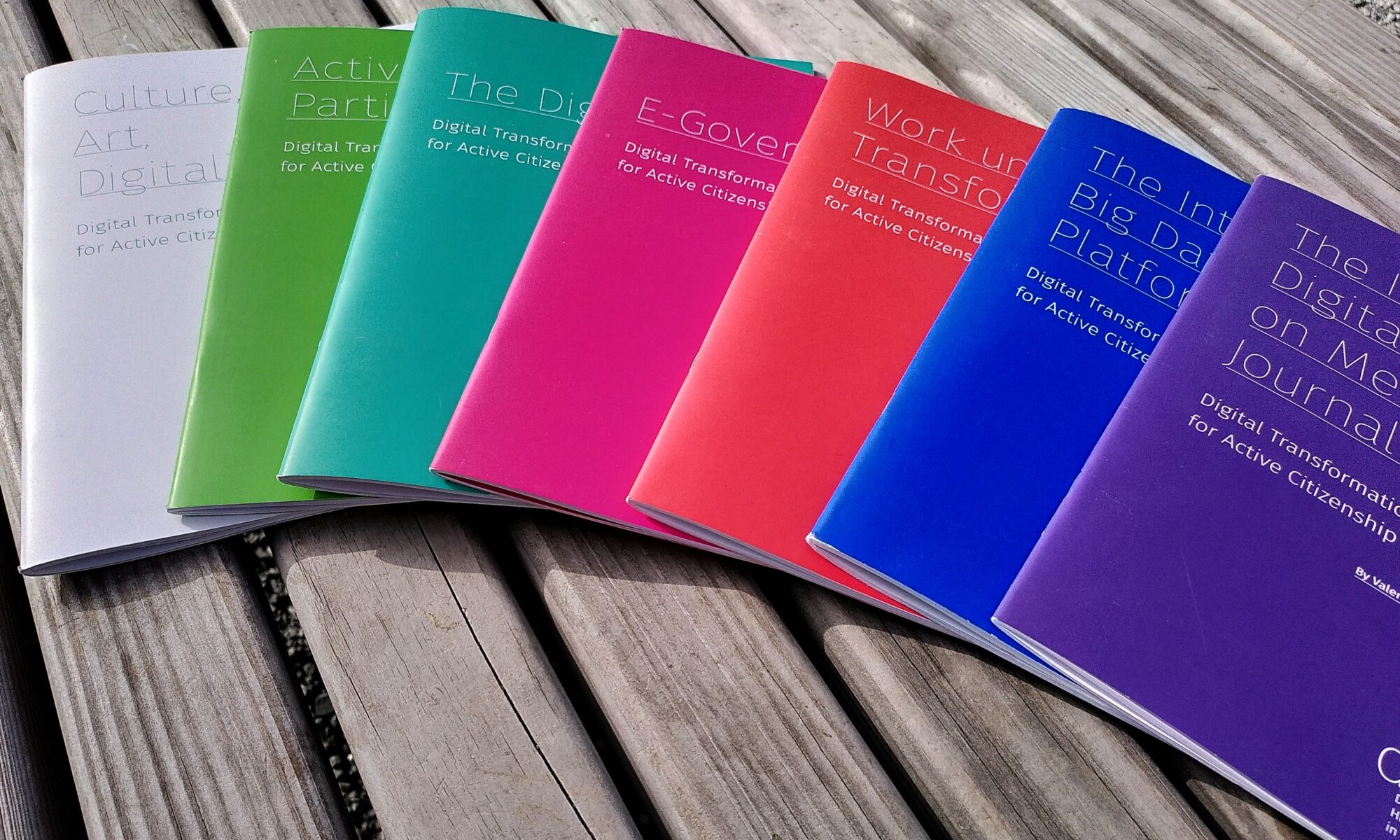
People are in different roles affected by the digital transformation
E.g., as users, learners, trainers, employees and active citizens. This multitude of roles that each person takes on demands an approach using themes and varied tools for framing and understanding the digital transformation.
Digital transformation and digital competence from the practice of Education for Democratic Citizenship and Human Rights Education. Created in the frame of the project DIGIT-AL – Digital Transformation in Adult Learning for Active Citizenship
M. Oberosler (ed.), E. Rapetti (ed.), N. Zimmermann (ed.), G. Pirker, I. Carvalho, G. Briz, V. Vivona.
We all know how ambiguous the digitalisation feels for many citizens in Europe. On the other hand, we understand that it contributes also to inclusion, participation and feeling well in our society. Is this contradictory?
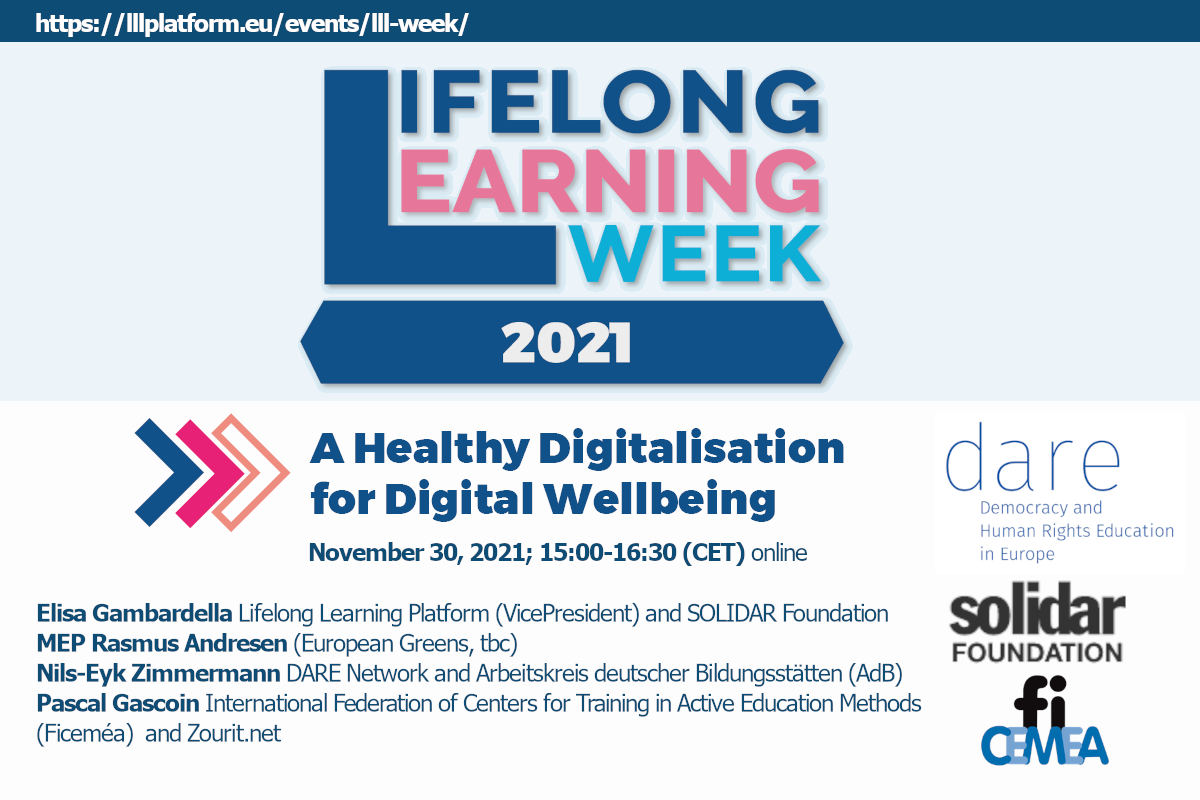
The DIGIT-AL project (Digital Transformation in Adult Learning for Active Citizenship) invites you to involve in a vivid debate on a healthy digitalisation for digital wellbeing at Tuesday, November 30 2021, 15:00-16:30 (Brussels) online.
The training in the framework of the DIGIT-AL project was focusing on needs and motivations of educators in order to understand the digital transformation and to include it more as a topic in their pedagogical practices. Hosted by the DARE member Rede Inducar, the participants from Portugal, Romania, Spain, Germany, Bulgaria, the United States and Italy explored the different concepts of digital competence and identified aspects which are in particular relevant for Education for Democratic Citizenship and Human Rights Education (EDC/HRE).
Today the Grundtvig Arward arrived by mail! The jury of the European Association for the Education of Adults selected this year the DIGIT-AL project in the category “transnational”. The project is coordinated by the DARE member Arbeitskreis deutscher Bildungsstätten and includes the member organisations Rede Inducar, Jan Tonissoni Instituut, EDC Latvia, Partners Bulgaria, CCI Trento and the DARE network.
The European Association for the Education of Adults awarded the project DIGIT-AL with the Grundtvig Award 2021 in the category “Transnational Project”. The ceremony will take place in the frame of the EAEA Annual Conference 2021: Learning to exercise democracy in a digital world on November 17/18, 2021.
“The Grundtvig Award is a great honor for us. It motivates us to continue on our path and work to ensure that more adult Europeans can learn fundamentally about digitisation as a major political and social issue. ”
On 12 and 13 October 2021, EPALE is hosting its annual Community Conference, which will be held entirely online. The conference will provide an opportunity to discuss how adult education and learning can help reshape our society, promoting inclusive and sustainable models.
The pandemic has exposed and exacerbated vulnerabilities in our globalised and interconnected world, with profound and long-lasting effects. Fast-paced changes on multiple levels – digital, demographic, and environmental – have been the norm in recent times. In this context, the conference revolves around the concept of transition. Transitions are full of uncertainty and instability, but being inherently transformative, they also provide an extraordinary opportunity to sketch out new models, paying particular attention to the challenge of not leaving anyone behind.
Positions and reflections from the perspective of Education for Democratic Citizenship/ Human Rights Education. From the project DIGIT-AL Digital Transformation in Adult Learning for Active Citizenship.
Published: 01/09/2021 G. Pirker, D. Kolarova (ed.) 58 pages, Brussels 2021
Cite: Georg Pirker (2021). Culture, Art & Digitalisation. Digital Transformation in Learning for Active Citizenship. DARE Blue Lines, DARE – Democracy and Human Rights Education in Europe, Brussels
With contributions from: Christiane Enkeler, Frank Elbers, Nils-Eyk Zimmermann
Digital Transformation impacts the field of arts and culture, but how do artists understand and explore digitalisation? The brochure explores how artists and art research are discussing the transformative process and to what initiatives and new dimensions of culture it could lead. On example of various practices it investigates the arts undergoing a change far beyond the field of production and “consumption”, exposing us to new philosophical frontiers of our understanding of nature and culture. Furthermore, it explores deeper what kind of questions and approaches arts and culture could offer also for civic education.
From the Table of Content
Introduction: Between Zero and One? Digital Everyday Culture Web Culture Characteristics of a Network Arts Arts, Culture and Civic Education
The Internet Cultures Interview with Joana Moll
Work between URL and IRL Work in the Networked Society Transformative Spaces for Digital Arts: Museums, Congresses, Festivals Interview with Aline Lara Rezende by Frank Elbers Glitches: From Euphoria to Datafication and Control Market and State-driven Surveillance Datafication and Immersive Art Approaches Supernerds – Article by Christiane Enkeler
Artificial Intelligence Creativity or Not? The Next Rembrandt
Inside and Insights of the Cultural Industry Algorithms and the Creative IndustryMusicPerforming ArtsLiterature and Writing Film Gaming as Learning Space, Games and Art The Great Art Upgrade by Paolo Pedercini Robots – Imagery of Digitalisation by Nils-Eyk Zimmermann